- 1 Quick Answer
- 2 What Problem Does This Article Solve?
- 3 WhatsApp Business App vs WhatsApp Business Platform (API): The Real Difference
- 4 WhatsApp Business API Cost in India: The Two Layers
- 5 Common Mistakes Business Owners Make
- 6 A Simple Way to Decide
- 7 Conclusion
- 8 Key Takeaways
- 9 Frequently Asked Questions
If you’re running a small business in India, you’re almost certainly already using WhatsApp to talk to customers. The question most owners eventually hit is whether the free app is still enough, or whether it’s time to pay for the WhatsApp Business API. This guide breaks that decision down honestly, including the real cost structure, which is genuinely in flux right now.
Quick Answer
The free WhatsApp Business app is enough for a small business run by one or two people replying manually to customers. You need the paid WhatsApp Business Platform (API) once you want a chatbot, multiple team members replying from one number, bulk marketing broadcasts, or CRM integration. The API itself has two costs: Meta’s per-message charge (roughly ₹0.86-1.10 for a marketing message, ₹0.11-0.25 for utility or authentication messages, figures that are being revised again around October 2026) plus a monthly platform fee to a provider like AiSensy, Interakt, or WATI, commonly somewhere in the ₹999 to ₹2,999 per month range on entry plans.
What Problem Does This Article Solve?
Most WhatsApp Business pricing content online is written by WhatsApp API providers themselves, which means it often either oversells the paid API to businesses that don’t need it yet, or buries the actual cost structure inside a “book a demo” call. On top of that, Meta has changed how it charges for API messages twice in the last year, so a lot of pricing guides online are already out of date the day they’re published.
This article gives you a straightforward answer: what the free app actually covers, when you genuinely need to pay, and an honest, clearly-flagged look at current API pricing so you’re not caught off guard by a bill that doesn’t match what you expected.
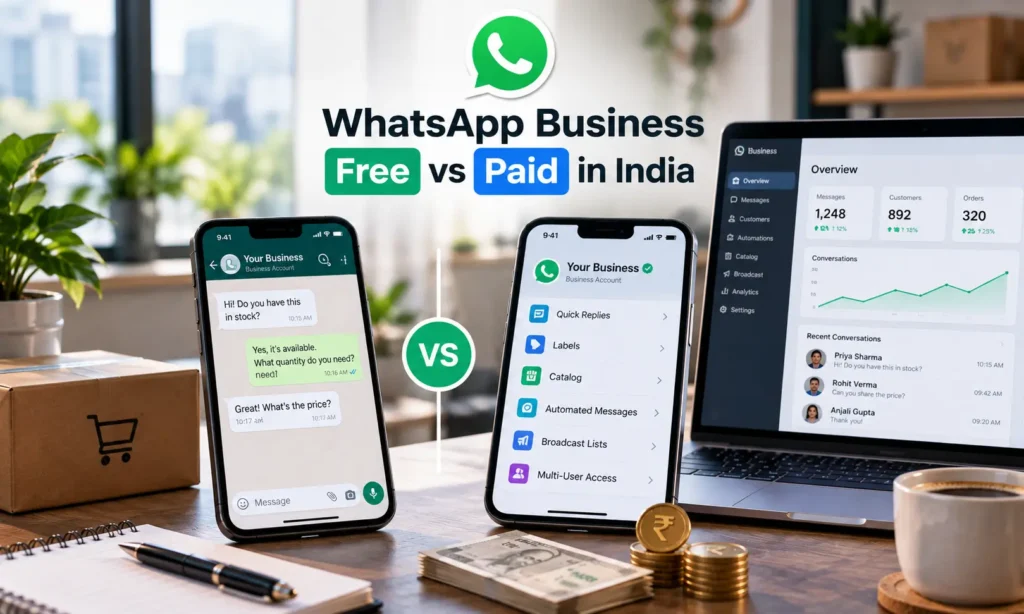
WhatsApp Business App vs WhatsApp Business Platform (API): The Real Difference
These are two different products, even though both carry the WhatsApp Business name.
| Feature | WhatsApp Business App (Free) | WhatsApp Business Platform / API (Paid) |
|---|---|---|
| Cost | Free | Meta’s per-message charges plus a provider’s monthly fee |
| Number of users per number | One phone (or linked devices) | Multiple team members via a shared inbox |
| Automated replies | Basic greeting and away messages, quick replies | Full chatbot flows, AI-assisted replies |
| Bulk marketing messages | Not designed for bulk broadcast, risks a ban if misused | Built for bulk marketing with Meta-approved templates |
| CRM or e-commerce integration | Not available | Available through most providers (Shopify, WooCommerce, CRMs) |
| Approval needed | None, download and use | Requires business verification through Meta and a provider |
| Best for | Solo shop owners, small service businesses, low daily message volume | Businesses with a support team, regular marketing campaigns, or high message volume |
When the Free App Is Genuinely Enough
If you’re a single shop owner, a tuition teacher, a freelancer, or a small service business handling a manageable number of daily conversations yourself, the free app covers the basics well: a business profile, a product catalog, an automatic greeting message, and quick replies for common questions. There’s no reason to pay for the API at this stage. Trying to send bulk promotional messages through the free personal-style app instead of proper marketing templates is also a common way small businesses get their number restricted, so this isn’t just about cost, it’s about staying within WhatsApp’s rules.
When You Actually Need the Paid API
The API becomes worth paying for once one of these becomes true for your business: you need more than one person replying from the same WhatsApp number, you want an automated chatbot handling common questions or orders, you’re sending regular marketing broadcasts (offers, restocks, festival promotions) to a customer list, or you want WhatsApp connected to your online store or CRM so orders and conversations sync automatically.
WhatsApp Business API Cost in India: The Two Layers
Understanding the API’s cost means understanding two separate charges that get bundled together in most providers’ pricing pages.
Layer 1: Meta’s per-message charge. As of January 2026 rate updates cited by multiple WhatsApp Business providers, Meta charges Indian businesses roughly ₹0.86 to ₹1.09 per marketing template message, and roughly ₹0.11 to ₹0.25 per utility or authentication template message (OTPs, order confirmations, delivery alerts). Meta shifted from charging per 24-hour conversation window to charging per individual template message in mid-2025, which is an important distinction if you’re comparing an older pricing guide to a current one. Several sources also describe a further change planned for October 1, 2026, where service messages and utility messages sent within an open 24-hour window, previously free, start being charged once a business exceeds a monthly free allowance commonly described as 1,000 free service messages per business phone number. Given how close that date is to today, and that even Meta’s own materials were reportedly inconsistent about it as recently as early September 2026, treat this specific change as something to verify directly on Meta’s official pricing page rather than take as settled.
Layer 2: Your provider’s platform fee. Since Meta doesn’t sell API access directly to most small businesses, you go through a Business Solution Provider (BSP) like AiSensy, Interakt, WATI, Gupshup, or similar platforms, which give you the actual dashboard, chatbot builder, and team inbox. These typically charge a monthly platform fee on top of Meta’s per-message rate, commonly somewhere in the ₹999 to ₹2,999 per month range for entry-level plans aimed at small businesses, sometimes with a small flat markup per message on top of Meta’s own rate. Some providers offer a free-forever tier with limited features and a low message volume, worth checking if you’re just starting out.
A realistic monthly estimate: a small business sending a modest volume of marketing messages, a few thousand a month alongside routine customer service replies, would likely land somewhere in the range of roughly ₹1,000 to ₹5,000 a month all-in once you combine a basic provider plan with Meta’s message charges. Some sources online quote far higher figures, tens of thousands of rupees a month, but those numbers often bundle in custom chatbot development, agency implementation fees, or high-volume enterprise use rather than a straightforward small business subscription. Don’t assume you need to spend that much to get started.
Finding the Cheapest Reliable WhatsApp API Provider in India
“Cheapest” and “reliable” don’t always point to the same provider, and pricing pages change often enough that naming one fixed winner here would likely be outdated within months. What’s worth checking when comparing providers: whether they charge a flat platform fee, a percentage markup on Meta’s rate, or both; whether there’s a free tier to test the product before committing; and whether basic chatbot and catalog features are included in the entry plan or reserved for higher tiers. Compare at least two or three current provider pricing pages directly before signing up, rather than relying on a single “best WhatsApp API India” ranking, since several of these are published by the providers themselves.
Common Mistakes Business Owners Make
- Paying for the API before actually needing more than one person replying or a chatbot
- Sending bulk promotional messages through the free personal-style app and risking a number restriction
- Not accounting for both cost layers (Meta’s per-message rate plus the provider’s platform fee) when budgeting
- Choosing a provider based on price alone without checking if basic features are locked behind a higher tier
- Assuming current pricing will stay the same, given how often Meta has revised its India rates recently
A Simple Way to Decide
- Track how many people currently need to reply to customers from your business number, one person managing it fine is a sign the free app is still enough.
- Note whether you’re already sending, or want to send, regular marketing broadcasts to a customer list, this is the clearest sign you need the paid API and Meta-approved templates.
- If you decide to move to the API, compare two or three current provider pricing pages directly, checking both the platform fee and the per-message pass-through rate.
- Start on the lowest tier that covers your actual current volume, you can upgrade as your broadcast list and team grow.
If you want structured help setting up WhatsApp marketing properly for your business, alongside your Google Business Profile and a simple AI-built website, the Business Growth course is built specifically around this. For a broader look at AI tool costs relevant to small businesses beyond WhatsApp, see what free AI tools actually cost in India.
Conclusion
Most small businesses in India don’t need to pay for WhatsApp until they outgrow what one person replying manually can handle. Once you do need the paid Business Platform, the real cost is two layers, Meta’s per-message rate and your provider’s platform fee, together usually landing in a modest monthly range for a small business rather than the much larger figures some pricing guides quote. Given how often Meta has revised its India rates recently, and a further change expected right around when this article is published, verify current pricing directly before you commit to a plan. Not sure where WhatsApp fits into your overall marketing plan? View all courses to compare.
Key Takeaways
- The free WhatsApp Business app is genuinely enough for a solo or very small business replying manually to customers.
- You need the paid WhatsApp Business API once you want a chatbot, multiple team members on one number, bulk marketing broadcasts, or CRM/e-commerce integration.
- API cost has two layers: Meta’s per-message charge and your provider’s monthly platform fee, both need to be budgeted together.
- Meta’s India per-message rates have changed more than once in the past year, and another change is expected right around October 2026, verify current rates before publishing any number as fact.
- A realistic small business estimate is roughly ₹1,000 to ₹5,000 a month all-in on an entry-level plan, much lower than some inflated figures floating around online that bundle in custom development costs.
- Sending bulk marketing messages through the free personal-style app risks getting your number restricted, this is a rules issue, not just a cost one.
- Don’t trust a single “cheapest WhatsApp API India” ranking, several are published by the providers themselves, compare at least two or three pricing pages directly.
- Start on the lowest API tier that matches your current volume and upgrade as your customer list grows.
Frequently Asked Questions
What is the difference between WhatsApp Business free app and WhatsApp Business API? The free app is a single-device app for one person to manage customer chats with basic automated replies. The paid API (WhatsApp Business Platform) supports multiple team members, chatbots, bulk marketing broadcasts, and CRM or e-commerce integration, accessed through a provider like AiSensy, Interakt, or WATI.
How much does WhatsApp Business API cost in India? As of recent rate updates, Meta charges roughly ₹0.86 to ₹1.09 per marketing message and ₹0.11 to ₹0.25 per utility or authentication message, plus a provider platform fee commonly in the ₹999 to ₹2,999 per month range on entry plans. These rates have changed more than once in the past year and are worth verifying directly before budgeting.
Is WhatsApp Business free for small businesses in India? Yes, the WhatsApp Business app itself is free to download and use. You only start paying once you move to the WhatsApp Business API for features like chatbots, bulk broadcasts, or multiple team members on one number.
What is the cheapest WhatsApp API provider in India? This changes often enough that naming one fixed answer isn’t reliable. Compare at least two or three current provider pricing pages directly, checking both the platform fee and Meta’s per-message pass-through rate, rather than relying on a single ranking, since several are published by the providers themselves.
Can I send bulk marketing messages on the free WhatsApp Business app? It’s not designed for that, and doing so risks your number being restricted or banned. Bulk marketing messages are meant to go through the paid WhatsApp Business API using Meta-approved message templates.
Is WhatsApp Business API pricing changing soon? Yes. Meta has already changed its India pricing model more than once in the past year, moving from per-conversation to per-message billing, and multiple sources point to a further change around October 1, 2026, affecting previously free service and utility replies. Verify current rates on Meta’s official pricing page before making a decision.
Do I need a developer to set up WhatsApp Business API? Not necessarily. Most providers like AiSensy, Interakt, and WATI offer no-code dashboards for setting up templates, chatbots, and broadcasts. A developer becomes useful for deeper custom integrations with your own website or CRM, but isn’t required to get started.
How many messages can I send for free on WhatsApp Business API? Providers commonly describe a monthly free allowance for service (customer support) messages, often cited around 1,000 per business phone number, though this detail is part of the pricing change expected around October 2026 and worth confirming at the time you check.
Ready to actually use WhatsApp to grow your business instead of just deciding which plan to pick? Explore the Business Growth course and learn WhatsApp marketing, your Google Business Profile, and a simple AI-built website together, built specifically for small business owners.
Explore the Business Growth Course