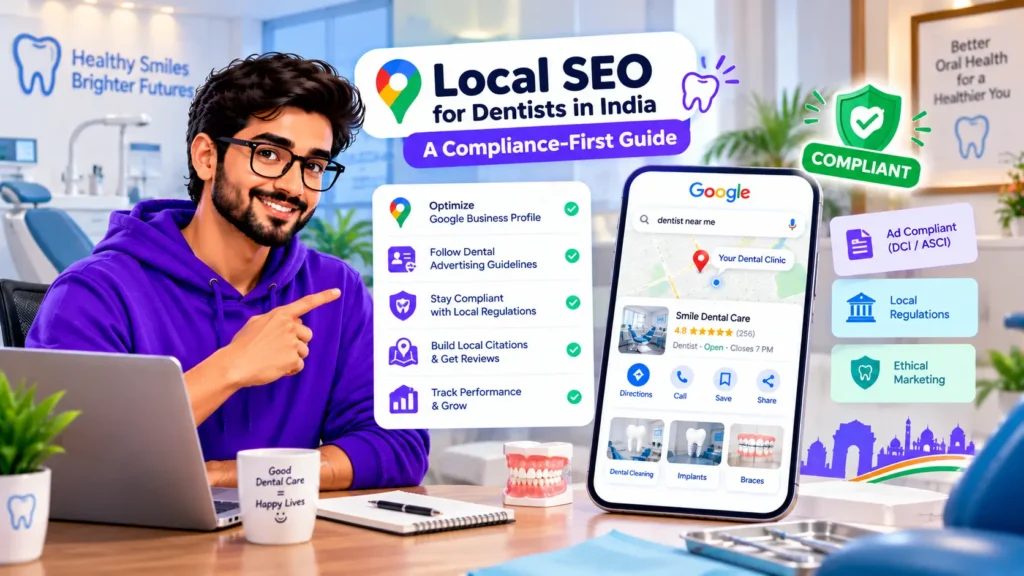
- 1 Why dentists need a different approach to local SEO
- 2 What the code says, in plain language
- 3 Step by step: a factual Google Business Profile for a dental clinic
- 4 What to keep out of your listing
- 5 Reviews and replies: check before you act
- 6 What to do next
- 7 Frequently asked questions
- 8 Want your clinic's listing checked for accuracy?
- 9 Sources
Why dentists need a different approach to local SEO
Most guides on local SEO for dentists come from countries where dental advertising is open. In India it is not. Dentists are bound by the Revised Dentists (Code of Ethics) Regulations, 2014, and on 14 October 2026 the Ethics and Dental Registration Board of the National Dental Commission reportedly issued an advisory warning registered dentists against unethical social media promotion and advertising. The advisory refers to the code’s rules on advertising, patient solicitation, confidentiality, publicity and signage, and says established violations can lead to disciplinary action, including suspension or removal from the dental registers.
That does not mean a dental clinic should be invisible online. It means the starting point is different: keep your public information accurate and factual, and check anything promotional with your council before you do it.
This guide explains what the code says in plain language, how it applies to your Google Business Profile, and what to keep out of your listing.
This is general information, not legal or professional advice. Rules can change and councils interpret them. Confirm anything you are unsure about with your State Dental Council or an advocate before acting.
What the code says, in plain language
The parts of the 2014 regulations that matter most for your online presence are these. The wording below is my paraphrase, so read the original clauses yourself.
| Topic | What the regulations say (paraphrased) | What it means for your Google listing (conservative reading) |
|---|---|---|
| Advertising in general (8.1) | A dentist may advertise, but only with decorum. Demeaning solicitation and false promises are unethical, as are misleading promotions, inducements and rebates, and using agents or canvassers to obtain patients commercially | Keep everything factual and calm. Do not use discounts, free-treatment offers or vouchers |
| Soliciting and self-promotion (8.2) | Soliciting patients directly or indirectly is unethical. A dentist should not publicize himself in a way that draws attention to his skill, achievements or specialties, and should not boast of cases, operations or cures | Avoid superlatives, success claims and case showcasing |
| Directories and the internet (8.2.8) | Listing in telephone directories, yellow pages or on the internet is permissible as public information. Any claim to superiority or special skills over others is unethical | A basic factual listing is consistent with the code. “Best dentist” style claims are not |
| Websites (8.2.9) | Websites are acceptable when the information is factual. They can include treatment facilities and fees, but must not make claims that are not factual or are misleading | Keep your website and profile text factual and consistent |
| Signs and naming (8.3, 8.10) | Signs should only indicate the location and entrance and carry limited details. A dentist cannot claim to be a specialist without a recognised qualification. A practice is called a dental clinic, and may be called a dental hospital only when it meets the stated conditions | Use your clinic name as it appears on your signboard. Do not add “hospital” unless you qualify. Be careful with specialist labels |
| Surrogate advertising (8.1.8) | Public education should not carry the clinic’s address, phone number or email in a way that attracts patients | Be careful with educational posts that include contact details |
| Confidentiality (4.2) | Information patients share in confidence should not be revealed except as the law requires | Never confirm that someone was a patient, or discuss treatment, in a public reply |
Step by step: a factual Google Business Profile for a dental clinic
The steps below keep to factual public information, which the code treats as acceptable. They do not promise rankings or patients.
1. Claim and verify your profile
Make sure the profile is yours and is verified, so that incorrect details cannot be shown and duplicates can be dealt with. If your clinic does not appear at all, read our guide on why your business is not showing on Google Maps.
2. Use your clinic name exactly as on your signboard
This is consistent with Google’s guidelines, and with the code’s rules on signs and naming. Do not add keywords, treatments, taglines or claims to the name. Do not use “hospital” unless your establishment meets the conditions in the regulations.
3. Choose categories carefully
Your main category should describe what the clinic is, usually a general dental category. Choose a specialist category only if the practitioner holds a qualification recognised by the council for that specialty. The code speaks about signboards and stationery, not online categories, so this is my conservative reading. Ask your council if you are unsure.
4. Keep address, phone number, hours and map pin accurate
These are the facts patients need to reach you. Check them regularly and update them when anything changes. The code allows an announcement of a change of address, so keeping the listing current is consistent with it.
5. Write a plain, factual description
Describe the clinic, the treatments offered and the location in neutral language. Leave out comparisons, rankings, “best”, “leading”, “painless”, “guaranteed” and any claim you cannot prove. The code treats claims of superiority or special skills as unethical.
6. Add factual photos
Photos of the entrance, reception and facilities help patients recognise the clinic. The code is concerned with boasting about cases, so it is sensible to avoid before-and-after case photos unless your council confirms they are acceptable.
7. Link to a factual website
The code accepts websites with factual information, including treatment facilities and fees. Make sure the website and the profile say the same thing.
8. Keep listings consistent everywhere
Wrong or mismatched details on other directories can confuse patients. Our guide to free business listing sites in India explains NAP consistency, which means keeping your name, address and phone number identical everywhere.
9. Check what patients see
Search your clinic name and your area the way a patient would, from different places. Our guides on how to check your Google Maps ranking and the Google local pack explain how local results are shown. This is for checking accuracy and visibility, not for chasing positions.
What to keep out of your listing
Based on the clauses above, treat these as red flags and check with your council before doing any of them:
- Superiority or special-skill claims. “Best dentist in Jaipur”, “No. 1”, “most experienced”.
- Offers and inducements. Discounts, free check-ups, vouchers, gifts, rebates.
- Boasting about cases or outcomes. Success stories, treatment showcases, case counts.
- Specialist labels without a recognised qualification.
- Educational content that carries contact details to attract patients.
- Patient information of any kind.
- Paid arrangements that obtain patients commercially. The code refers to agents and canvassers for obtaining patients. Before you sign with any marketing agency, including ours, ask your council whether the arrangement is acceptable.
Reviews and replies: check before you act
I could not find the code addressing Google reviews directly, so this is an area to ask your council about instead of guessing. Three points to keep in mind:
- Confidentiality comes first. A public reply that confirms someone was your patient, or mentions their treatment, risks breaching the confidentiality rule. If you reply at all, keep it general and move the conversation offline.
- Soliciting is restricted. The code treats soliciting patients directly or indirectly as unethical. Whether asking patients to review the clinic counts is a question for your council.
- Google has its own rules. Paid or incentivized reviews are not allowed, and neither is selectively asking only happy customers for reviews.
What to do next
- Read Regulation 8 of the 2014 code yourself, and any newer notices from the National Dental Commission and your State Dental Council.
- Write to your State Dental Council with specific questions: what is acceptable on a Google profile, with photos, with reviews, and with agency support.
- Fix the basics above: accurate name, address, phone, hours and pin.
- Review your whole profile against the lists in this guide. Our local SEO checklist and Google Business Profile optimization guide cover the general work, but apply them with the cautions above in mind.
Frequently asked questions
Can a dentist in India have a Google Business Profile?
The 2014 regulations, as published, say that listings in directories or on the internet are permissible as public information, as long as there is no claim to superiority or special skills. Confirm the current position with your council.
Is local SEO for dentists legal in India?
I am not a lawyer, and I cannot give a yes or no. The code allows factual information and prohibits solicitation, misleading promotion and boasting. Keeping your listing accurate and factual is the safest approach, and anything more should be checked with your council.
Can I call my clinic “the best dentist” on Google?
The regulations treat claims of superiority or special skills over others as unethical. Do not use it.
Can I offer discounts or free check-ups on my Google profile?
The code lists inducements, rebates and similar promotions among unethical advertising practices. Check with your council before doing it.
Can I show patient photos, testimonials or before-and-after images?
I could not find a clear rule for online testimonials. The code does restrict boasting of cases, and confidentiality applies. Ask your council before using any of them.
Can I hire a marketing agency to get more patients?
The code refers to agents and canvassers who obtain patients commercially. Ask your council whether a specific arrangement is acceptable before you sign.
Do these rules apply to doctors too?
Doctors are governed by medical regulations, not the dentists’ code. Check the current rules from the National Medical Commission and your State Medical Council.
Dentist ke liye Google par listing karna theek hai?
2014 ke Dentists Code of Ethics ke anusaar internet par factual public jaankari dena theek mana gaya hai, lekin dusron se behtar hone ke daave, offers, discounts ya apni kaamyabi ka pradarshan sahi nahi hai. Apni clinic ka naam, pata, phone aur timing sahi rakhein. Kuch bhi promotional karne se pehle apni State Dental Council se confirm karein.
Want your clinic’s listing checked for accuracy?
A clinic’s Google listing should be accurate, consistent and easy to find. If your listing is missing, duplicated, or shows wrong details, that is a fixable problem.
On a call, Ankit looks at your profile and tells you whether it needs ranking work, optimization, or both, and what to fix first. This is a review of listing accuracy and visibility, not legal advice, and you should confirm anything promotional with your dental council.
[Book a call with Ankit](BOOKING LINK) and get a clear plan to rank or optimize your Google Business Profile.
See also our local SEO services, the comparison of agency vs DIY Google Business Profile optimization, and the guide to Google Business Profile optimization cost in India.
Sources
- Revised Dentists (Code of Ethics) Regulations, 2014, Regulations 3.4, 4.2, 8.1, 8.2, 8.3 and 8.10, as published on the Legitquest legal database.
- National Dental Commission warns dentists against unethical social media advertising, Medical Dialogues, reporting the advisory dated 14 October 2026.