When I tell marketers that I’ve been optimising for ChatGPT and Google AI Overviews since before most teams had even added them to their reporting dashboards, the reaction is usually one of two things: scepticism, or a flood of questions.
I get it. For the last decade, SEO meant rankings on the ten blue links. You optimised for Google’s crawlers, chased DA scores, built backlinks, and watched your position on page one. That playbook worked brilliantly — and honestly, it still matters. But something significant has shifted in how people actually find information, and if your marketing strategy hasn’t accounted for it yet, you’re already behind.
This article is my attempt to give you a practical, no-jargon explanation of GEO (Generative Engine Optimisation) and AEO (Answer Engine Optimisation) — what they actually mean, how they’re different from traditional SEO, and most importantly, what you can start doing about them today.
Want to Learn AI Digital Marketing Enroll Now!
First, understand what changed
Traditional search works like a library index. You type a query, Google retrieves and ranks pages it thinks are most relevant, and you click through to find your answer. The search engine is a middleman — it points you somewhere else.
AI-powered search works differently. When someone asks ChatGPT “what’s the best VPN for Windows?”, or Google’s AI Overview summarises “how to fix duplicate content issues”, the AI is generating an answer directly. It’s synthesising information from multiple sources and presenting a response — often without the user ever clicking a link.
This is the fundamental shift. The search engine is no longer just a directory. In many cases, it’s become the destination.
For marketers, this creates a new challenge: if the AI answers the question without sending traffic to your site, how do you make sure your brand, your product, and your expertise are part of that answer?
That’s exactly what GEO and AEO are designed to solve.
What is AEO (Answer Engine Optimisation)?
AEO is about structuring your content so that answer engines — Google’s featured snippets, voice search, and AI assistants — can directly extract and use it as a response.
Think about how Google’s featured snippet works. When someone searches “how long does SEO take to show results?”, Google often shows a boxed answer at the top of the page pulled directly from one website. That website didn’t necessarily rank #1 — it just had the clearest, most directly structured answer to that specific question.
AEO is the discipline of intentionally creating that kind of content.
In practice, AEO means:
Identifying the specific questions your audience asks — not just the keywords they search — and structuring your content to answer those questions clearly and concisely. A good rule of thumb: if you can’t give a useful answer in 40–60 words, your content isn’t structured for AEO.
It also means using FAQ sections extensively. Not generic FAQs written for filler, but genuine question-and-answer pairs that mirror exactly how people phrase queries to Google Assistant, Siri, or Alexa. Adding FAQ schema markup to these sections signals to search engines that this content is structured as a direct answer.
Finally, AEO rewards precision. Instead of writing “SEO is a complex discipline that involves many different factors across technical, on-page, and off-page dimensions…”, write “SEO typically takes 3–6 months to show measurable results for new websites, depending on domain authority, competition, and content consistency.”
One is an introduction. The other is an answer.
What is GEO (Generative Engine Optimisation)?
GEO goes a step further. While AEO focuses on traditional answer engines and featured snippets, GEO specifically addresses how to get your content cited, referenced, or synthesised by large language models like ChatGPT, Perplexity, Google Gemini, and the AI Overviews in Google Search.
When ChatGPT answers a question about cloud telephony tools in India, it’s drawing from its training data and, increasingly, from live web sources it retrieves at query time. The brands and experts that appear in those answers didn’t get there by accident. They got there because their content had the specific qualities that make it trustworthy, citable, and easy for an AI to use.
What GEO optimisation looks for:
The most important factor is what I call citation-worthiness. AI models tend to reference content that reads like it comes from a genuine expert or authoritative source — not content that’s clearly written to rank. Think: original data, first-hand experience, clear attribution, and specific claims backed by numbers.
Entity optimisation is also central to GEO. AI systems understand the world through entities — named people, companies, products, and concepts — and the relationships between them. If your content consistently associates your name or brand with a specific expertise area (say, “GEO optimisation for SaaS brands in India”), over time the AI builds a model that recognises that association.
Structured data also matters significantly. Schema markup for your organisation, your authors, your products, and your articles helps AI systems understand not just what your content says, but who is saying it and why it should be trusted.
Learn With AI Tool Check out Best AI Tool for Digital Marketing
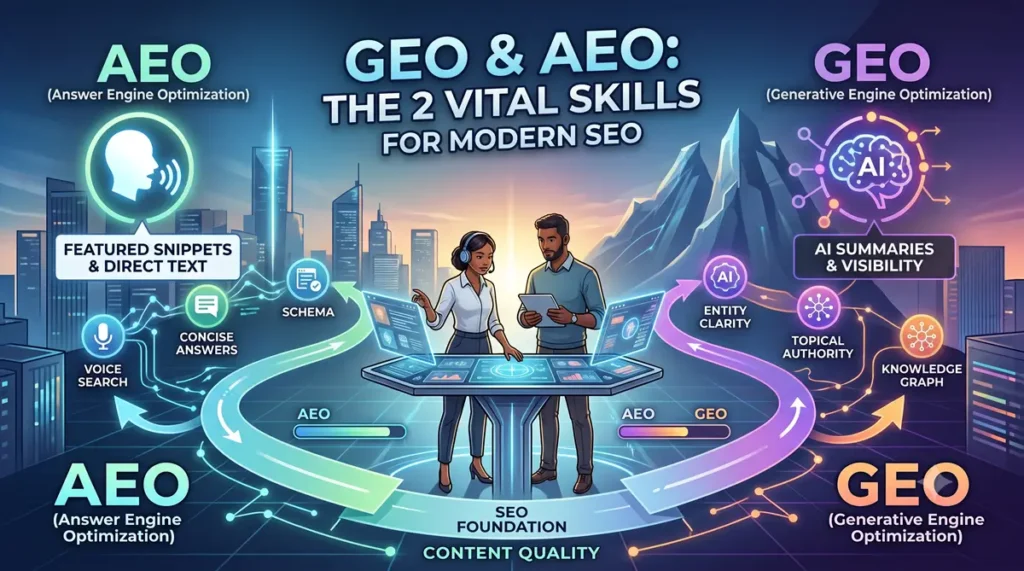
GEO vs AEO vs SEO: how they fit together
These aren’t competing disciplines — they’re layered. Think of it this way:
Traditional SEO gets your page indexed, ranked, and found in the ten blue links. It’s still the foundation. Without it, the rest doesn’t work.
AEO ensures that when your page is found, it’s structured in a way that earns featured snippets and voice search answers. It’s about being the clearest, most direct answer in the room.
GEO ensures that when AI systems generate responses about your topic, your content, your brand, or your expertise is part of what they draw on. It’s about being cited in conversations that increasingly happen without a search results page at all.
A simple way to think about it: SEO gets you on the shelf. AEO gets you on the front shelf. GEO gets you recommended by the shop assistant.
What you can do starting this week
Here are five practical things you can implement immediately, regardless of what CMS or marketing stack you’re on.
1. Audit your FAQ content. Go through your existing blog posts and product pages. For every piece of content, ask: does this page directly answer a specific question? If not, add a FAQ section at the bottom that does. Use tools like AnswerThePublic or simply look at the “People Also Ask” section in Google for your target keywords — those are the exact questions you need to be answering.
2. Add structured FAQ schema. Once you have FAQ sections, mark them up with FAQ schema (JSON-LD format). This is a few lines of code your developer can add in an hour, and it immediately signals to Google that this content is structured as a Q&A. If you’re on WordPress, plugins like Rank Math or Yoast make this straightforward.
3. Write one “definitive guide” post per quarter. AI systems tend to cite comprehensive, authoritative resources. Identify one topic in your niche where there isn’t a genuinely exhaustive guide and write it. Not 800 words — a real guide with original perspective, structured headings, and specific data. This is the kind of content that earns citations.
4. Optimise your “About” and author pages for entity clarity. Make sure your website clearly defines who you are, what you specialise in, and what credentials you hold. Use consistent language across your site and your LinkedIn profile. AI systems cross-reference these sources when building their understanding of who you are.
5. Include original data or first-hand insight in every post. Even small original data points — “in my experience managing $50K/month in ad spend, the biggest ROAS killers are…” — make your content far more citable than generic rewrites of what everyone else has already said.
The honest truth about where this is going
I want to be direct about something: nobody fully knows how AI search will evolve over the next two to three years. Google is iterating on AI Overviews at a pace that makes traditional SEO shifts look slow. ChatGPT Search is still relatively young. Perplexity is growing fast.
What I am confident about, based on everything I’ve seen over the last two years of implementing these strategies, is this: the brands and marketers who build content that is genuinely useful, clearly structured, and built around real expertise will be rewarded in AI-driven search — just as they’ve always been rewarded in traditional search.
GEO and AEO aren’t tricks. They’re not a new set of loopholes to exploit. They’re disciplines that ask you to think harder about whether your content actually deserves to be cited. In most cases, that means doing better marketing — not just different marketing.
Start there. The technical implementation follows naturally.
Is your content ready for AI-driven search? If you’d like to discuss a GEO/AEO strategy for your business, I’m available for consulting. Connect with me on LinkedIn or drop me a message — let’s talk.