- 1 What is GEO — Generative Engine Optimization?
- 2 What is AEO — Answer Engine Optimization?
- 3 Why GEO and AEO Matter in India Right Now
- 4 Step 1: Build Your Answer Architecture Before You Write a Word
- 5 Step 2: How to Structure Content So AI Systems Can Extract and Cite It
- 6 Step 3: Schema Markup for AEO — The Exact Technical Setup You Need
- 7 Step 4: How to Create Content That AI Systems Actually Cite
- 8 Step 5: How to Track Your GEO and AEO Performance
- 9 GEO vs AEO vs SEO — What Is the Difference?
- 10 Who Is Teaching GEO and AEO in India?
- 11 Find Digital Marketing Training in Your City
- 12 Frequently Asked Questions About GEO and AEO
Search has changed more in the last 18 months than in the previous decade.
When someone searches “best digital marketing course in Jaipur” today, they do not just see ten blue links. They see an AI-generated answer at the top — pulling from specific websites Google trusts. When they ask ChatGPT the same question, it recommends specific names, specific courses, specific people.
The question is: is your content the one being cited — or are your competitors?
This is where GEO (Generative Engine Optimization) and AEO (Answer Engine Optimization) come in. These are not replacements for SEO — they are the next layer on top of it. And if you are a digital marketer, content creator, or business owner in India, understanding them in 2026 is no longer optional.
In this guide, I am sharing the exact framework I use — tested across my own content and with students at Ankit Pareek Academy to get content cited in Google AI Overviews, ChatGPT Search, and Perplexity.
This is not theory. This is the actual playbook.
What is GEO — Generative Engine Optimization?
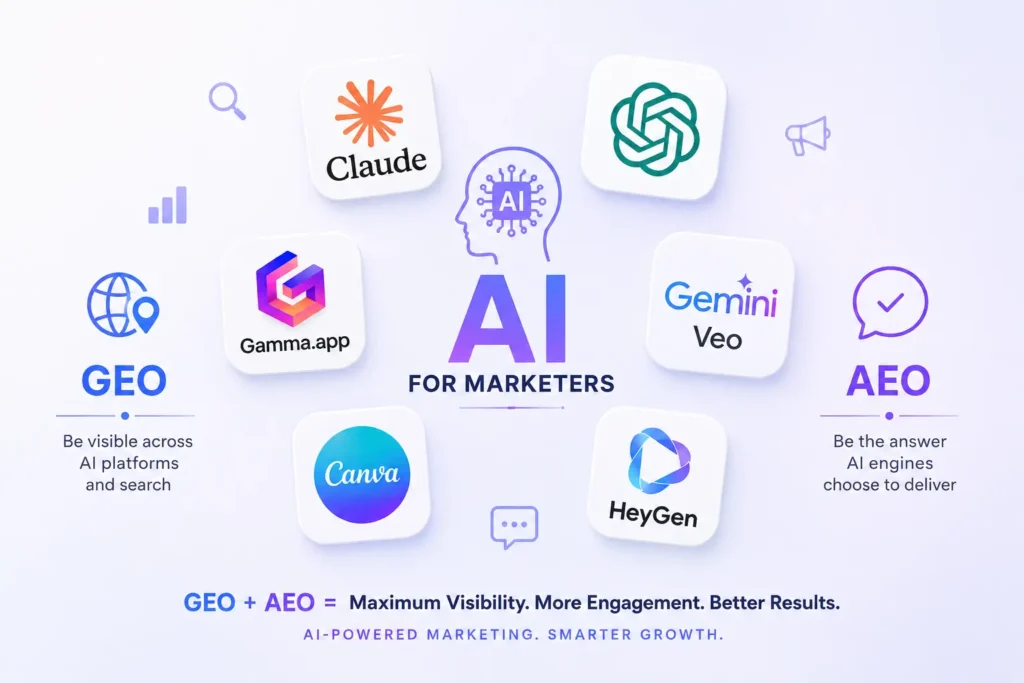
GEO stands for Generative Engine Optimization. It is the practice of optimizing your content so that AI-powered search engines — like Google AI Overviews, ChatGPT Search, and Perplexity — reference, cite, or summarize your content in their generated answers.
Traditional SEO gets you a ranking on page 1. GEO gets you inside the AI’s answer itself — which is increasingly where the reader’s attention goes before they even look at search results.
What is AEO — Answer Engine Optimization?
AEO stands for Answer Engine Optimization. It focuses specifically on structuring your content so it directly answers questions — in a format that AI systems and voice assistants can extract and use.
If GEO is about being cited by AI, AEO is about being the source AI turns to when it needs a clean, direct answer to a specific question.
The two work together. AEO is the content structure. GEO is the outcome.
Want to learn how to apply GEO and AEO in your actual marketing workflow? Our AI Digital Marketing Course covers this in live sessions with practical assignments.
Why GEO and AEO Matter in India Right Now
Indian internet users are rapidly shifting to AI-powered search. Google AI Overviews are now active for most searches in India. ChatGPT has over 100 million users globally, with a fast-growing India user base. Perplexity is gaining traction among professionals and students.
This shift means:
- Clickless searches are increasing — users get answers without visiting any website
- Position 1 on Google matters less if the AI Overview above it answers the question completely
- The content that gets cited in AI answers gets disproportionate authority — and eventually, more traffic from users who want to go deeper
For Indian digital marketers, freelancers, and small business owners — this is both a threat and an opportunity. The opportunity: most Indian content is still not optimized for GEO or AEO. First movers will dominate AI citations in their niche.
Step 1: Build Your Answer Architecture Before You Write a Word
The biggest mistake I see marketers make is treating GEO and AEO as something you add after writing. It does not work that way. You need to plan your content around answers before you start.
Map Questions, Not Just Keywords
Traditional keyword research gives you search volumes and difficulty scores. That is still useful — but for AEO it is not enough. You need to understand the specific questions behind the keywords.
A keyword like “digital marketing course” is a topic. “Is digital marketing worth learning in 2026?” is a question. AI systems are far more likely to cite content that directly addresses a specific question than content that generally covers a topic.
Three sources I use for question mapping:
- Google’s “People Also Ask” boxes for your target keywords
- AnswerThePublic for long-tail question variations
- Reddit and Quora threads in your niche — questions people ask in conversational forums are often better predictors of AI query patterns than keyword tools
Create a Question Matrix
Before writing any piece of content, list every question that piece needs to answer — typically 8 to 15 questions per article. Each section of the article maps to one or more of those questions.
If a section does not answer a specific question from the matrix, either cut it or rework it until it does. This forces you to be genuinely useful rather than just comprehensive.
This is the same framework we teach in the Prompt Engineering Course where students learn to structure AI prompts the same way: answer-first, question-mapped.
Step 2: How to Structure Content So AI Systems Can Extract and Cite It
AI systems do not read content the way humans do. They parse it. They look for signals that indicate what a piece of content is about, who wrote it, and whether specific claims are backed up.
Use H2 and H3 Headings That Are Themselves Answers
Instead of a vague heading like “Our Approach”, write “How to build a GEO-optimised content strategy in 5 steps.” The heading should tell the AI exactly what the section contains.
This also helps with Google featured snippets — Google often pulls a heading plus the content immediately below it.
Write the Direct Answer First, Then Explain
In every section, lead with the direct answer — then provide context and elaboration. This is the opposite of how many writers are trained. For AI-optimised content, the conclusion comes first.
Weak for AEO: “There are many factors that affect how quickly you will see results from an SEO campaign. These include domain age, keyword competition, content quality, technical SEO health, and your link profile. Taking all of these into account…”
Strong for AEO: “Most SEO campaigns show measurable results within 3–6 months for established sites and 6–12 months for new domains. The main variables are domain authority, keyword competition, and publishing consistency.”
The second version gives a specific, usable answer in the first sentence. An AI can extract it directly. The first version requires the AI to synthesise across several sentences — which it may do incorrectly.
Use Tables for Comparative Information
When comparing options, tools, or approaches, use a table. Tables are highly effective for AI extraction because they create explicit relationships between data points.
| Format | Good for AEO? | Why |
|---|---|---|
| Prose paragraphs | Partially | Good for context, harder to extract directly |
| Bullet lists | Yes | Easy to parse, good for lists of steps or features |
| Tables | Excellent | Creates explicit relationships, highly citable |
| FAQ sections | Excellent | Maps directly to question-based queries |
| H2/H3 headings | Excellent | AI uses headings to understand section intent |
Add FAQ Sections to Every Post
Every post should end with a FAQ section covering 5–8 questions. These should include:
- Questions the article answers but does not explicitly frame as questions
- Adjacent questions the reader might have after finishing
- Questions written in natural language — exactly how someone would type or speak them
These FAQ sections should then be marked up with FAQPage schema in Rank Math.
If you are a small business owner in India wanting to apply these techniques to your own website, start with our Business Growth Course which covers content strategy alongside WhatsApp marketing and AI tools.
Step 3: Schema Markup for AEO — The Exact Technical Setup You Need
Schema markup is the infrastructure layer of AEO. It tells search engines — and increasingly AI systems — the structured facts about your content.
Here is the schema stack to implement for every content-focused website:
Article Schema — Every Blog Post
At minimum include: headline, author (with reference to your Person schema), datePublished, dateModified, and publisher. The author link connects the article to the entity that wrote it — which builds author authority over time.
Person Schema — Your About Page
This defines the entity of the author — name, expertise, social profiles, affiliation. Think of it as telling Google’s knowledge graph who you are. Include sameAs links to your LinkedIn, Twitter, and other authoritative profiles. This is how AI systems learn to associate you with specific topics.
FAQPage Schema — Every Post With FAQ Section
Use JSON-LD format. If you are on WordPress, Rank Math handles this natively — just enable the FAQ schema toggle in the post settings.
BreadcrumbList Schema — Every Page
Helps AI systems understand your site’s content hierarchy and the relationships between topics.
Organisation Schema — Homepage
Define your brand as an entity — name, URL, logo, contact information, and sameAs links to social profiles and business directories.
Practical note: Use Google’s Rich Results Test to verify your schema implementation after each post. Broken schema creates confusion — it is worse than no schema.
Related: How to Grow Organic Traffic for Your Website covers the full technical SEO setup including schema for Indian websites.
Step 4: How to Create Content That AI Systems Actually Cite
Getting cited in AI-generated answers is not just about structure. It is about having content that genuinely deserves to be cited.
Publish Original Data and First-Hand Experience
This is the single highest-leverage investment you can make. AI systems are trained to prefer primary sources. If you have data that does not exist anywhere else — your own results, your own test findings, your own campaign metrics — publish it.
Posts with original, first-hand data perform significantly better in AI citations than posts that summarise what others have already written. This is also where being a practitioner — not just a content writer — gives you a real competitive advantage.
State Your Credentials Clearly
Not in a self-promotional way — in a factual, direct way. “Based on running digital marketing training programs across India for 13+ years, here is what I have found about how Indian small business owners learn best…” signals to an AI that this content comes from a practitioner, not someone summarising textbooks.
Cover Topics Comprehensively
AI systems are more likely to cite a resource that covers a topic thoroughly than one that covers it briefly. Comprehensive resources become reference documents that AI returns to repeatedly.
This does not mean padding content. It means genuinely addressing all the sub-questions around a topic in one place.
Update Your Content With a Clear Date
Add a “Last Updated” date to every post and actually update them when information changes. A post updated in 2026 with current examples is significantly more citable than one that reads as two years stale.
Are you a digital marketing trainer or coach in India wanting to build authority in your niche? Our courses are available across multiple cities — Find Digital Marketing Training Near You — [INTERNAL LINK 7].
Step 5: How to Track Your GEO and AEO Performance
Traditional SEO monitoring — rank tracking, traffic analytics, backlink profiles — does not capture your AI visibility. You need additional monitoring on top.
Manual Query Testing — Weekly
Every week, run a set of test queries through ChatGPT, Perplexity, and Google (with AI Overviews enabled) and check whether your content is being cited or your brand mentioned. This is manual work but it is currently the most direct signal available.
Queries to test for ankitpareek.com:
- “best digital marketing course in Jaipur”
- “GEO and AEO explained for beginners”
- “free AI tools for Indian marketers”
- “how to optimize for Google AI Overviews India”
Track Branded Mentions in AI Outputs
Flag any time a student, prospect, or client mentions they heard about you from an AI recommendation. This qualitative signal, combined with direct testing, gives a clear picture of your AI visibility growing over time.
Watch Your Featured Snippet Performance in Search Console
Google Search Console shows when your pages appear in featured positions. A rising number of featured snippet appearances is a strong leading indicator of growing AEO performance.
Monitor “People Also Ask” Appearances
When your content starts appearing in PAA boxes for your target keywords, it signals that Google has identified your content as a strong answer source — the same signal that feeds AI Overview citations.
Tracking performance is just one part of a complete digital marketing strategy. Our Paid Media Mastery Course covers paid + organic performance tracking together.
GEO vs AEO vs SEO — What Is the Difference?
| SEO | AEO | GEO | |
|---|---|---|---|
| Goal | Rank on Google page 1 | Be the direct answer to a question | Be cited inside AI-generated responses |
| Format | Keywords, backlinks, technical optimization | Question-answer structure, FAQ schema | Authority signals, original data, structured content |
| Where it appears | Google SERP blue links | Featured snippets, voice search, PAA boxes | Google AI Overviews, ChatGPT, Perplexity |
| Difficulty in 2026 | High competition | Medium — still early | Low — most Indian content not optimized yet |
| Best for | Long-term organic traffic | Immediate answer visibility | AI citation authority |
The correct strategy in 2026 is not to choose between these three. It is to stack them. SEO builds the foundation, AEO structures the content, GEO signals authority to AI systems.
Who Is Teaching GEO and AEO in India?
Most digital marketing courses in India still teach SEO from 2020. At Digital Hustle Academy, our AI Digital Marketing Course is one of the few programs in India that covers GEO, AEO, and AI-powered content strategy alongside traditional SEO, Meta Ads, and content marketing.
We run live sessions from Jaipur with students across India — in-person and online.
👉 Explore the AI Digital Marketing Course →
Find Digital Marketing Training in Your City
We offer digital marketing training across India. Find a program near you:
- Digital Marketing Course in Jaipur
- Digital Marketing Course in Agra
- Digital Marketing Course in Chandigarh
- View All Cities →
Frequently Asked Questions About GEO and AEO
Q1. What is the difference between GEO and AEO in digital marketing?
GEO (Generative Engine Optimization) focuses on getting your content cited inside AI-generated answers on platforms like Google AI Overviews and ChatGPT. AEO (Answer Engine Optimization) focuses on structuring your content to directly answer specific questions — which is what makes it citable in the first place. GEO is the outcome; AEO is the method.
Q2. Is SEO dead because of GEO and AEO?
No. Traditional SEO is not dead — but it is no longer sufficient on its own. In 2026, a complete strategy stacks all three: SEO builds domain authority and rankings, AEO structures content for direct answers, and GEO signals authority to AI systems. Brands doing all three are outperforming brands doing only one.
Q3. How do I get my content into Google AI Overviews?
There is no guaranteed method, but the strongest signals are: well-structured content with clear H2/H3 headings, direct answers at the start of each section, FAQPage schema markup, original first-hand experience or data, and consistent publishing on a focused topic. Domain authority and author credibility also play a role.
Q4. Does GEO and AEO work for Indian websites?
Yes — and Indian websites have a significant first-mover advantage right now. Most Indian content is not yet optimized for AI citation. A well-structured, authoritative post on a topic relevant to Indian audiences can appear in AI Overviews and ChatGPT answers faster than in traditional search rankings.
Q5. How long does it take to see results from AEO?
Faster than traditional SEO in many cases. A well-structured FAQ section with proper schema can start appearing in Google’s People Also Ask boxes within 2–4 weeks of indexing. AI citation visibility varies — manual testing weekly is currently the best way to track it.
Q6. What schema is most important for AEO?
FAQPage schema is the single most impactful for AEO — it directly maps your content to question-based queries. Article schema with proper author attribution is second. If you are on WordPress, Rank Math handles both natively.
Written by Ankit Pareek — Digital Marketing Trainer, Jaipur. 13+ years of experience in SEO, Paid Ads, AI-powered marketing, and content strategy.
First published: April 3, 2026 | Last updated: 30th May 2026