- 1 Quick Answer
- 2 What Problem Does This Article Solve?
- 3 What a Local SEO Audit Checklist Actually Covers
- 4 1. Google Business Profile Checklist
- 5 2. NAP and Citation Consistency Checklist
- 6 3. Website Local SEO Checklist
- 7 4. Reviews and Reputation Checklist
- 8 5. Technical and Mobile Checklist
- 9 6. Local Keyword and Content Checklist
- 10 What's Changed Recently Worth Knowing
- 11 Common Mistakes Found in Local SEO Audits
- 12 How Often Should You Audit?
- 13 A Simple Way to Start
- 14 Conclusion
- 15 Frequently Asked Questions
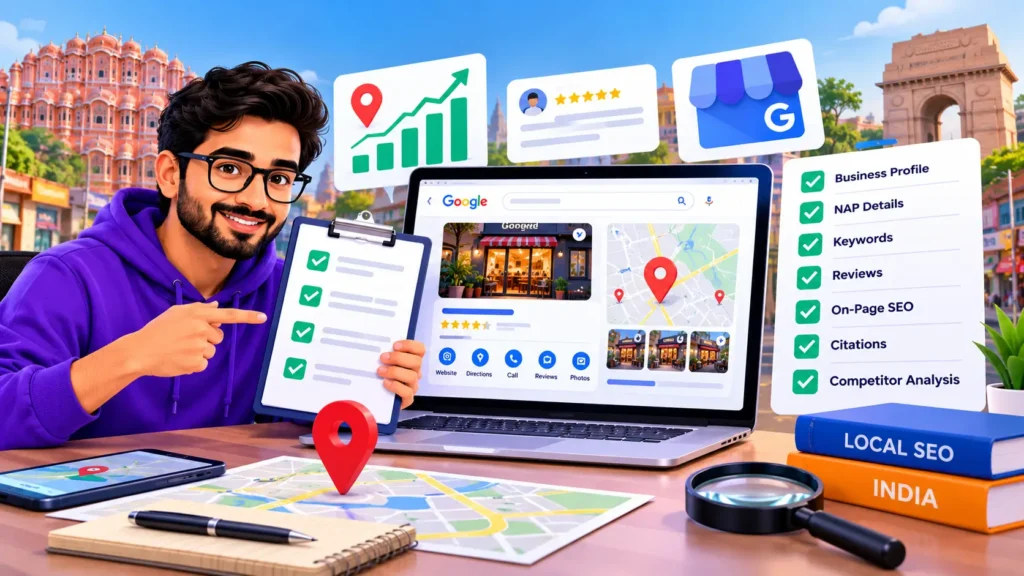
If you’ve never formally audited your local SEO, chances are a few basic things are quietly holding your business back, a wrong business category, an inconsistent phone number across listings, or a profile that hasn’t been touched in months. This Local SEO audit checklist walks through exactly what to check, in order of impact, so you can find and fix these gaps yourself.
Quick Answer
A local SEO audit checks five areas: your Google Business Profile, your website’s local SEO elements, your NAP (name, address, phone) consistency across online listings, your reviews and response activity, and basic technical health like mobile-friendliness and page speed. Most small businesses should run through this checklist every 3 to 6 months. Google Business Profile and NAP consistency have the biggest impact on local rankings, so if you only have time for part of this checklist, start there.
What Problem Does This Article Solve?
Most local SEO advice online is either too theoretical (explaining what local SEO is without telling you what to actually check) or too long (40-point checklists with no sense of what matters most). Small business owners in India usually don’t have a marketing team to delegate this to, so what’s actually useful is a clear, ordered list: check this first, then this, and here’s what each one is actually for.
This checklist is built around that. It’s organized by impact, so you can do the highest-value parts even if you only have an hour to spare, and expand from there.
What a Local SEO Audit Checklist Actually Covers
A proper audit evaluates five areas: your Google Business Profile, your website’s local SEO elements, citation and NAP consistency across directories, your review activity, and basic technical health. Google’s own documentation names relevance, distance, and prominence as the three factors behind local ranking, everything in this checklist feeds into improving prominence and relevance, since distance is determined by the searcher’s location and isn’t something you can directly control.
1. Google Business Profile Checklist
Your Google Business Profile is the single biggest lever in local SEO. If you only check one section of this list, make it this one.
- Profile is claimed and verified (check if verification is current, Google’s verification process, including video verification for some new listings, has changed in recent updates)
- Business name matches your actual signage exactly, no extra keywords stuffed in
- Primary category is the single most accurate match for your core business, this is one of the most common mistakes, picking a broader or slightly wrong category
- Secondary categories added for any additional relevant services
- Complete address, correctly pinned on the map
- Phone number is a local number that actually rings at the business
- Business hours are accurate, including holiday hours during festivals
- Website link is correct and working
- Business description is written for customers first, mentioning your services and area naturally, not stuffed with keywords
- At least 15-20 real photos uploaded, exterior, interior, products or services, team
- Products or services section filled in with clear names and descriptions
- At least one Google Post published in the last two weeks
- Q&A section has your 5-6 most common customer questions pre-answered
2. NAP and Citation Consistency Checklist
NAP means your business Name, Address, and Phone number. Inconsistent NAP across the internet is one of the most common, and most fixable, local SEO problems.
- NAP on your website (especially the footer and contact page) matches your Google Business Profile exactly, character for character
- NAP is consistent across major directories you’re listed on (Justdial, Sulekha, IndiaMART, or industry-specific directories relevant to you)
- No duplicate or old Google Business Profile listings exist for your business under an old address or closed location
- Any old citations with a previous phone number or address have been updated or removed
3. Website Local SEO Checklist
Your website should reinforce the same local signals as your Google Business Profile, not contradict them.
- Your city or service area is mentioned naturally in page titles, headings, and body content, not stuffed repeatedly
- A dedicated page exists for each service area if you serve multiple localities or cities
- Contact page includes your full NAP, a Google Maps embed, and business hours
- LocalBusiness schema markup is added to your site, if you’re not sure what this is, it’s a small piece of code that helps Google understand your business details, your website developer or SEO provider can add this
- At least one page clearly explains what makes your business different from nearby competitors
4. Reviews and Reputation Checklist
Review activity, not just review count, is a meaningful local ranking signal. A steady stream of recent reviews tends to matter more than a large number of old ones.
- You have a simple, repeatable way to ask satisfied customers for a review, a QR code, a direct link shared after service
- You’re responding to every review, positive and negative, within a few days
- Negative reviews are responded to professionally, without arguing publicly with the customer
- You are not purchasing fake reviews or using review-exchange groups, Google’s detection for this has gotten more aggressive and can lead to profile suspension
- Review responses mention your business name and service naturally where appropriate, without sounding forced
5. Technical and Mobile Checklist
Most local searches happen on a phone, so these basics affect whether a potential customer can even use your site once they find it.
- Website loads in a reasonable time on mobile data, not just on office Wi-Fi
- Website is genuinely mobile-friendly, test it on your own phone, not just a desktop preview
- Click-to-call phone number works correctly on mobile
- “Get Directions” or map links work correctly from your website
6. Local Keyword and Content Checklist
- You know the specific terms customers actually search for (your city or locality plus your service), not just guesses
- Your Google Business Profile description and website both use these terms naturally
- You occasionally publish content relevant to your local area, a seasonal offer, a local event you’re part of, or an answer to a locally-common customer question
What’s Changed Recently Worth Knowing
A few things worth double-checking if your last local SEO work was done more than a year or two ago: some new Google Business Profile verifications now require video verification rather than just a postcard or phone call, so budget a little extra time if you’re setting up a new listing. AI-generated answers are increasingly appearing for “best near me” type searches before a user even sees the traditional map results, which connects local SEO more closely with the broader shift toward AI search visibility covered in GEO and AEO: the two skills every SEO professional needs right now. Both of these are worth confirming are still accurate at the time you’re reading this, since Google updates these processes without much public notice.
Common Mistakes Found in Local SEO Audits
- Wrong or overly broad primary category on Google Business Profile, often the single biggest fixable issue
- NAP inconsistency between the website and the Google Business Profile, sometimes from an old address or phone number never fully updated everywhere
- A profile that was set up once and never touched again, no posts, no new photos, in months
- Ignoring negative reviews instead of responding professionally
- Treating the audit as a one-time task instead of something to repeat every few months
How Often Should You Audit?
Most small businesses benefit from running through this checklist roughly every 3 to 6 months, and immediately after any major change, a new address, new services, a rebrand, or a dip in calls or visibility you can’t otherwise explain. A quick monthly check of just the Google Business Profile section (recent posts, review responses, photo freshness) between full audits helps keep things from going stale.
A Simple Way to Start
- Block out one hour and go through the Google Business Profile and NAP sections first, these have the highest impact and are the fastest to check.
- Fix what you can yourself immediately, missing photos, an outdated phone number, an unanswered review.
- Note anything requiring technical help (schema markup, page speed issues) to raise with your website developer.
- Set a recurring reminder every 3 to 6 months to repeat the full checklist.
If you want to learn how to do this properly and apply it as an ongoing skill rather than a one-time checklist, the Google My Business Optimization course walks through exactly this, and the free GMB class is a good way to see the approach before committing. Student results show what past learners have done with these skills.
Conclusion
Most local SEO problems aren’t complicated once you know where to look, a wrong category, an inconsistent phone number, a profile nobody’s touched in months. This checklist gives you an order of priority: Google Business Profile and NAP consistency first, since they have the biggest impact, then website, reviews, and technical health. Running through it every few months catches small issues before they become the reason a customer couldn’t find or trust your business online. Want structured help turning this into a repeatable process? View all courses to compare.
Frequently Asked Questions
What is a local SEO audit checklist? It’s a structured list of everything to check across your Google Business Profile, website, online listings, and reviews to find gaps hurting your visibility in local search results and Google Maps.
What’s the most important part of a local SEO checklist? Google Business Profile optimization and NAP (name, address, phone) consistency across your website and directory listings are generally considered the highest-impact areas to check first.
How often should I audit my local SEO? Most small businesses benefit from a full audit every 3 to 6 months, plus a quick monthly check of Google Business Profile activity (posts, reviews, photos) in between.
Can I do a local SEO audit myself? Yes. Most of this checklist, checking your Google Business Profile details, NAP consistency, and review responses, doesn’t require technical skill, just time and attention. A few technical items, like schema markup, may need help from a web developer.
Does my Google Business Profile category really matter that much? Yes, choosing the wrong or an overly broad primary category is one of the most common issues found in local SEO audits, and one of the easiest to fix once identified.
Do I need a lot of reviews to rank well locally? Not necessarily a large total number. A steady, recent flow of reviews, and how you respond to them, tends to matter more than having hundreds of old reviews with no recent activity.
What tools do I need for a local SEO audit? For most of this checklist, you don’t need any paid tool, just your Google Business Profile dashboard, your website, and a phone to test mobile usability. Paid citation-checking tools can help for larger businesses with listings across many directories.
Is a local SEO audit different for a business with multiple locations? The same checklist applies to each location individually, each needs its own accurate, complete Google Business Profile and consistent NAP, plus dedicated location pages on your website rather than one generic page covering every branch.
Want to turn this checklist into an ongoing skill instead of a one-time fix? Explore the Google My Business Optimization course and learn to audit, optimize, and maintain local rankings properly, practical skills for your own business or to offer as a service.