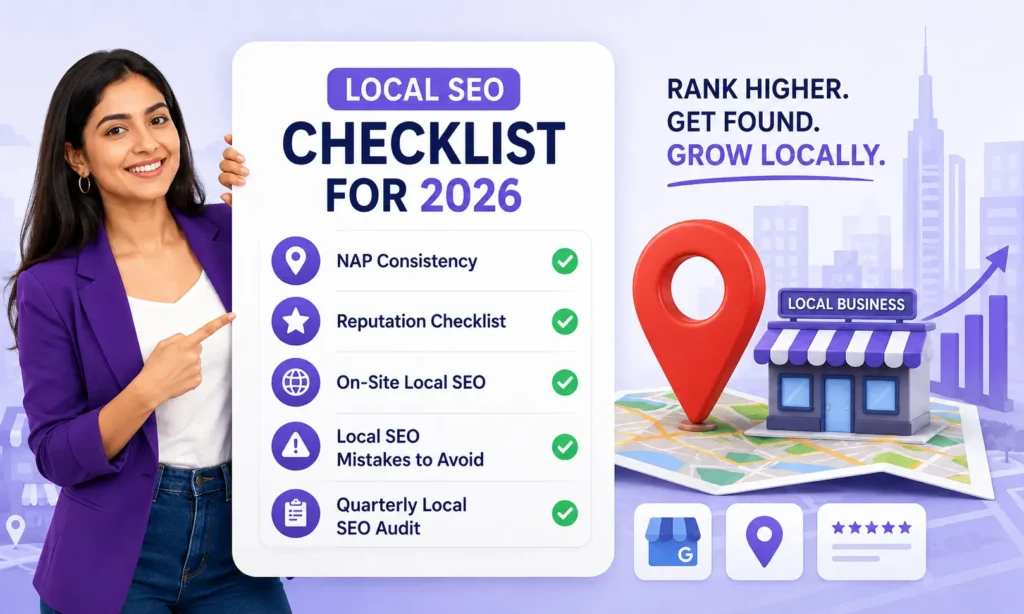
Ranking higher in local search comes down to a handful of things done consistently, not one big trick. This checklist covers every major piece: your Google Business Profile, your citations, your reviews, and your website itself. Work through it section by section and you will cover most of what actually moves local rankings. This Local seo checklit will help you to understand and optimize your GBP profile much better.
If you want the full story behind any single piece of this checklist, we have gone deeper on several of these topics already. Our Google Business Profile optimization guide covers GBP in detail, and our guide to ranking higher on Google Maps covers the Maps-specific side of things.
Google Business Profile Checklist
Your Google Business Profile (also called GMB, from its older name) is the foundation of local SEO. Work through this before anything else:
- Claim and verify your listing
- Choose the most specific primary category available, not the broadest one
- Add every relevant secondary category
- Complete your business description fully, without keyword stuffing
- Add your correct hours, including special holiday hours
- Upload photos regularly, not just once at setup
- Post updates through GBP Posts on an ongoing basis, not as a one-time task
If your business does not have a walk-in location, this checklist works a little differently. We have a full breakdown in our guide to local SEO without a physical address, which covers Service Area Business setup specifically.
If you would rather have this done for you instead of managing it yourself, our GBP optimization service covers exactly this. If you want to learn the framework and do it in-house, our GMB Optimization course walks through it step by step.
1. NAP Consistency & Citations Checklist
NAP stands for Name, Address, and Phone number. Google checks whether this information matches across the internet, and inconsistency is one of the most common, and most avoidable, local SEO problems.
- Confirm your business name is written identically everywhere, no abbreviations in one place and full words in another
- Confirm your address format matches exactly, including things like “St” versus “Street”
- Use a local phone number with the correct area code, not a toll-free number, since toll-free numbers can look like spam signals to Google
- List your business on major directories relevant to your market
- Fix or remove any duplicate listings you find under an old name or address
- Recheck this list every few months, since directories and business details change over time
This part of local SEO is unglamorous but it matters. A single wrong address on one directory can quietly work against everything else you are doing.
2. Reviews & Reputation Checklist
Reviews influence both your ranking and whether a potential customer actually calls you. Google’s own guidance confirms that prominence, which includes review volume and quality, is one of the three core local ranking factors, alongside relevance and distance.
- Build a simple, repeatable process for asking every satisfied customer for a review
- Ask right after a successful project or purchase, when the experience is freshest
- Respond to every review, positive and negative, promptly and professionally
- Never buy fake reviews or offer incentives for reviews, since this violates Google’s guidelines and risks your listing being suspended
- Take any serious complaints offline to resolve them, rather than arguing in public review replies
- Track review velocity over time, not just your overall star rating
I do not have a verified, universal number for exactly how many reviews you need to compete in your specific market, since this depends heavily on your city, category, and competitors. Rather than quoting you a generic number, I’d suggest checking what your top three competitors currently have and treating that as your real benchmark.
3. On-Site Local SEO Checklist
Your website needs to reinforce every signal your GBP profile sends to Google. This is the part many businesses skip, assuming GBP alone is enough.
- Add your city or service area naturally into page titles and headings, not stuffed in unnaturally
- Create a dedicated page for each city or region you genuinely serve, rather than one generic page trying to cover all of them
- Add LocalBusiness schema markup to your homepage and contact page
- Make sure your NAP information on your website matches your GBP listing exactly
- Include a genuine, embedded Google Map on your contact page where relevant
- Build local backlinks through partnerships, local press, or guest contributions to local publications
If you are debating whether your city pages need a full rebuild or just a few fixes, our local SEO services page covers what a proper audit and fix typically involves.
4. Common Local SEO Mistakes to Avoid
- Treating your GBP profile as a one-time setup instead of something you maintain
- Using a fake or inconsistent address just to appear closer to a target area, which risks suspension
- Copying the same city-page content across multiple locations with only the city name swapped
- Ignoring reviews for weeks or months at a time
- Chasing every possible keyword instead of picking the categories and terms that genuinely match your business
- Assuming there’s a way to pay for a better ranking. There isn’t. Google has been explicit that local ranking cannot be bought or requested directly.
5. Quarterly Local SEO Audit Checklist
Beyond the ongoing tasks above, it helps to run a deeper audit every quarter rather than only reacting when rankings drop. This catches slow-building problems before they cost you visibility.
- Recheck every directory listing for outdated information, since business details drift over time even when you haven’t changed anything intentionally
- Search your own business name in an incognito browser window to see how your listing actually appears, since personalization can otherwise skew what you see
- Compare your review count and rating against your top three local competitors, not just against your own past numbers
- Review which categories and services are actually driving calls or direction requests, and adjust your GBP services list accordingly
- Check for duplicate listings that may have been created accidentally, especially after a rebrand, a move, or a change in categories
- Confirm your website’s local landing pages still reflect your current service areas and offerings accurately
Treat this quarterly pass as a checkpoint, not a one-time fix. Local SEO rewards consistency over big, occasional pushes.
How to Track Whether the Checklist Is Working
Two official Google tools are worth checking regularly to see if this checklist is actually moving the needle. Google Business Profile Insights, built into your profile dashboard, shows how customers found your listing and what actions they took, such as calls, direction requests, or website visits. Google Search Console shows whether your local landing pages are indexed and which queries they’re appearing for.
Reviewing both on a monthly basis gives you an early read on progress. Waiting several months without checking either one means you might not notice a problem, like a dropped listing or a broken NAP match, until it has already cost you visibility for a while.
Not every business has the time to work through this checklist every month on their own. If you are weighing whether to manage this yourself or bring in support, our Agency vs. DIY comparison walks through exactly how to decide, including the cost tradeoffs involved.
Whichever path you take, the fundamentals in this checklist do not change. What changes is who is doing the work.
If you want to see how this all comes together in practice, our work page and results page show examples of what consistent local SEO execution looks like over time. And if you’re new to Digital Hustle Academy, our about page and full course lineup are good starting points.
FAQ Section
Q: How long does it take to see results from a local SEO checklist like this? A: I do not have a verified, universal timeline to give you, since this depends heavily on your starting point, competition, and category. Businesses starting from an incomplete or unverified profile often see faster early movement than businesses that were already mostly optimized. I’d recommend tracking your own baseline and re-checking monthly rather than expecting a fixed number of weeks.
Q: Is Google Business Profile the same as Google My Business or GMB? A: Yes. Google renamed Google My Business to Google Business Profile, but many people, and search terms, still use GMB. The checklist items are the same regardless of which name you use.
Q: Can I pay Google for a better local ranking? A: No. Google has stated directly that there is no way to request or pay for a better local ranking. Rankings are based on relevance, distance, and prominence, not advertising spend.
Q: What’s the single most common mistake businesses make on this checklist? A: Based on what shows up repeatedly across local SEO guidance, treating Google Business Profile as a one-time setup rather than ongoing work is the most frequently cited mistake. I don’t have a verified ranking of “most common” beyond that pattern, so treat this as a strong signal rather than a definitive ranking.