- 1 Key Summary
- 2 Is the Market Actually Booming?
- 3 How Is AI Changing This Field?
- 4 Is SEO and Social Media Still Worth Learning?
- 5 Video, AI Search, and What's Changing Fast
- 6 Where Are the Jobs? (By Industry and City)
- 7 Skills and Salary in Digital Marketing
- 8 Freelance and Remote Work
- 9 What People Get Wrong
- 10 FAQ
- 11 Conclusion
- 12 Sources Use in This Paper
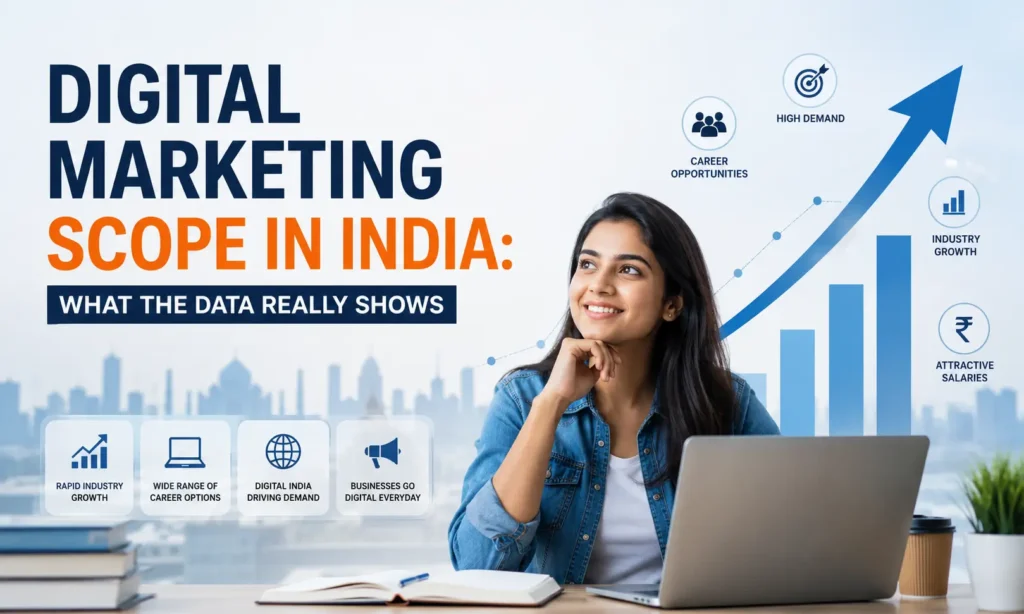
A clear, evidence-based look at where digital marketing in India stands today — the market size, job demand, AI’s impact, and what it means if you’re building a career here.
A quick note before you read: Different research firms report different numbers for this industry. Some measure only ad spend; others measure the full marketing industry. So the figures below don’t always match each other. Where a number is well-supported across sources, we say so. Where it isn’t, we flag it clearly. Always double-check anything time-sensitive before using it in ads or pricing pages.
Key Summary
- India’s digital ad spend hit about ₹947 billion (~$11 billion) in FY2025. Digital has now passed TV as India’s top ad category. (Source: Statista, based on EY data)
- India’s whole media industry grew about 9% to ₹2.78 trillion in 2025, and digital is now the biggest part of it. (Source: FICCI–EY report)
- Most research firms project 15–30% yearly growth for the next 5 years, with the exact figure varying by methodology.
- Restaurants, small businesses, and D2C brands now depend on digital marketing to survive, not just to grow.
- Freelance and remote digital marketing work is growing fast, backed by government data (NITI Aayog).
- AI is reshaping which skills pay well. Available evidence points to skill transformation rather than job loss, though this is a directional trend rather than a settled figure.
Is the Market Actually Booming?
Yes. Every source confirms growth is happening — they simply disagree on the exact numbers.
Here’s what different firms report for market size:
| Source | Figure | Growth rate |
|---|---|---|
| Expert Market Research | $6.71 billion (2025) | 30% a year to 2035 |
| Grand View Research (ads only) | $13.6 billion (2024) | 15% a year to 2030 |
| IBEF | $6.46 billion (2024) | ~28% a year (past growth) |
| 6Wresearch | Not given | 11% a year (2026–2032) |
| FICCI–EY (ad revenue only) | ₹947 billion (2025) | Rising toward 55%+ of all ad spend |
Each firm defines “digital marketing” a little differently, which explains the spread. The safest, most defensible summary across all five sources: most research firms expect India’s digital marketing industry to grow 15–25% per year for the next several years. No source above contradicts this.
What’s driving the growth:
- India has crossed 1 billion internet users (Source: DataReportal)
- Regional-language content consumption is rising sharply, beyond just English and Hindi
- Over a million small businesses now advertise online in India (Source: FICCI-EY, reported by Open Magazine)
Want to build a career in this growth? Check out Ankit’s AI Digital Marketing course.
How Is AI Changing This Field?
AI is not replacing digital marketers. It’s changing what they do.
- A large share of Indian marketing leaders — one industry survey puts it at 71% — plan to invest in AI tools this year.
- Google, Meta, and Adobe have all launched new AI ad tools for India in 2026.
- AI now handles repetitive tasks — like writing basic ad copy or managing bids — freeing up marketers for strategy, creativity, and judgment.
This is the consistent view across industry sources, though it should be read as a strong directional trend rather than a long-term guarantee. As AI tools mature, the balance of human vs. automated work will keep shifting — which is exactly why staying current on AI skills matters.
Checkout Best AI Tools For India
AI skills matter more every year. Ankit’s Prompt Engineering course teaches you to use AI tools well, not get replaced by them.
Is SEO and Social Media Still Worth Learning?
Yes — but being a “generalist” is getting harder. Specializing pays more.
- Digital ad spend keeps rising as a share of total marketing budgets in India (44% in 2023, heading toward 55%). More spend means more people are needed to run these campaigns.
- Basic social media and SEO skills are becoming common. Technical SEO, paid ads, and the new field of AI-answer optimization (see below) pay better.
- A new skill called AEO/GEO (Answer Engine Optimization) is showing up everywhere in 2026. It means writing content so AI tools like ChatGPT and Google’s AI Overview can find and use it.
Simple answer: SEO and social media aren’t dying. But knowing the basics alone is no longer enough.
Video, AI Search, and What’s Changing Fast
Video is one of the best-supported trends in this report, with strong data behind it:
- India’s OTT (streaming) video market is expected to reach $4.96 billion in 2026 (Source: Statista)
- Regional-language content now makes up 56% of what people watch on OTT platforms, up from 27% in 2020 (Source: FICCI-EY)
- Around 40 million Indian homes now use smart/connected TVs
AI search (AEO/GEO) is the newest trend in this space. It’s widely discussed across marketing circles, but large-scale India-specific studies measuring its actual size and ROI are still limited. Treat specific claims about AEO/GEO adoption or returns as early-stage and evolving rather than settled benchmarks — this is a space to watch closely through 2026–2027.
Where Are the Jobs? (By Industry and City)
Media & entertainment (like news sites, OTT platforms): Strongly supported by data. This is a ₹2.78 trillion industry, and digital is now its biggest part.
Restaurants and local food business: Directionally supported but less rigorously measured. Widely cited stats like “72% of diners research online first” originate mainly from marketing-agency research rather than large-scale independent surveys — useful as an indicator, but not a hard benchmark.
Small business and D2C brands: Strongly supported. India’s D2C market is projected to reach $60 billion by 2030 (IBEF), with some estimates going considerably higher — Mordor Intelligence projects $322 billion by 2031. The wide range reflects differing methodologies, but the direction is consistent: this is a genuinely fast-growing space.
Cities: Delhi NCR, Mumbai, Bengaluru, Hyderabad, and Pune are the most consistently named hiring hubs across sources. Tier-2 cities like Indore, Jaipur, Chandigarh and Lucknow are emerging as well.
Want to grow your local business online? Ankit’s Business Growth page can help.
Skills and Salary in Digital Marketing
Skills that pay well right now, based on multiple industry sources:
- Performance marketing (Google Ads, Meta Ads)
- Using AI tools for content, data, and reporting
- Marketing automation (HubSpot, Zoho)
- Technical SEO
- Short video and regional-language content
Important: A certificate alone doesn’t get you hired. Across every source reviewed, real project experience is the consistent differentiator for hiring.
Salary ranges (compiled from training-industry reporting on Glassdoor/Naukri/AmbitionBox data — treat as market indicators rather than official government figures):
Read Full Detailed Article on Digital Marketing Salary Here
| Level | Reported range |
|---|---|
| Fresher | ₹2.5–3.5 LPA |
| Fresher with real project experience | ₹3.5–6 LPA |
| Mid-level specialist | ₹8–15 LPA |
| 5–7 years experience | ₹12–20+ LPA |
| Senior roles | up to ₹18–25 LPA |
Performance marketing is the most consistently high-paying skill in this data. Ankit’s Paid Media Mastery course is built around exactly this.
Freelance and Remote Work
This is one of the better-sourced sections of this report, anchored in government data rather than marketing blogs alone.
- NITI Aayog — India’s government policy think tank — projects the gig workforce will grow from about 7.7 million (2020-21) to 23.5 million by 2029-30. This figure is consistently reported across multiple independent news outlets, which strengthens confidence in it.
- India’s freelance platform market is valued at $265 million (2025) and expected to reach $1.5 billion by 2033 (Source: Grand View Research)
- India is widely described as the world’s largest freelancer market, with estimates of 15 million+ freelancers.
Freelancing has real downsides too: there’s no formal safety net for freelancers in India yet, payment delays are common, and platform fees eat into earnings.
What People Get Wrong
- “Certificates alone get you a job.” Not true, based on every source reviewed. Real work matters more.
- “Entry-level jobs are easy to get.” Not really. Starting salaries are modest and competition is high, even as the industry overall grows fast.
- “Freelancing means more money automatically.” Not guaranteed. Freelancers in India face payment delays and no safety net.
FAQ
Is digital marketing a good career in India in 2026? The data supports “yes” for people who build real skills and a portfolio. It’s a weaker path for people who only collect certificates and expect quick results.
What is the scope of digital marketing in India? Growing fast — most research firms agree the industry will keep growing at 15–25%+ per year for the next several years, even though estimates of today’s exact size vary.
What salary can I expect in digital marketing? Freshers typically start around ₹2.5–3.5 LPA. This rises quickly with real project experience and specialization.
Will AI replace digital marketing jobs? Current evidence points toward AI changing the job more than eliminating it — automating repetitive tasks while increasing demand for strategy and judgment.
Is SEO dead because of AI search tools like ChatGPT? No, based on the sources reviewed. SEO and the newer AI-search discipline (AEO/GEO) work together, not against each other. AEO/GEO is still an emerging field without large-scale India benchmarks yet.
Which cities have the most digital marketing jobs in India? Delhi NCR, Mumbai, Bengaluru, Hyderabad, and Pune are named most often. City-level data for Jaipur specifically is not yet available in public research.
Conclusion
The direction is clear: India’s digital marketing industry is growing, and growing fast, no matter which report you check. Businesses of every size — from restaurants to D2C brands to news publishers — now depend on it.
What’s less settled is the exact size of the industry, exact job counts, and city-by-city numbers — an honest reality of a fast-moving sector where research firms use different methodologies. That transparency is what makes this report reliable.
If you want to enter this field, the data is clear: build real skills, especially in performance marketing and AI tools, and build a portfolio of real work. Don’t rely on certificates alone.
Sources Use in This Paper
- Statista — India digital ad revenue: statista.com/statistics/233493
- Statista — India digital marketing spend share: statista.com/statistics/388489
- Statista — OTT Video market, India: statista.com/outlook/amo/media/tv-video/ott-video/india
- IBEF — India’s E-commerce Boom: ibef.org/industry/ecommerce
- Expert Market Research — India Digital Marketing Market: expertmarketresearch.com/reports/indian-digital-marketing-market
- Grand View Research — India Digital Advertising Market: grandviewresearch.com/horizon/outlook/digital-advertising-market/india
- Grand View Research — India Freelance Platforms Market: grandviewresearch.com/horizon/outlook/freelance-platforms-market/india
- Mordor Intelligence — India D2C E-commerce Market: mordorintelligence.com/industry-reports/india-d2c-ecommerce-market
- Open Magazine (reporting FICCI–EY Media & Entertainment Report 2026): openthemagazine.com
- NITI Aayog — India gig workforce projections
- NASSCOM–Aon gig-hiring report (as reported across industry publications)
- DataReportal — India internet-user figures
This report uses data from late 2024 to mid-2026. Always verify any number before using it in paid ads, investor material, or pricing pages.